
Ilia Malinin entered Friday’s men’s figure skating final as a massive favorite to claim gold at the 2026 Winter Olympics. Still, despite initially holding a comfortable lead over second place, he faltered in his performance with multiple mistakes on the ice.
That led to an eighth-place finish for Malinin, which certainly wasn’t what he or his fans envisioned for him heading to the Olympic Games in Milano Cortina, Italy. Nonetheless, he picked himself up and, despite failing to reach the podium for a medal, still offered congratulations to Friday’s gold medal winner, Mikhail Shaidorov of Kazakhstan.

At the heavily-watched event, Yuma Kagiyama won silver, and Shun Sato won bronze. Sadly, Malinin’s attempt at a second gold medal in the Milano Cortina Games didn’t come to fruition after he fell on the ice and failed to land moves that would likely have resulted in a medal.
Many notable spectators, including former Olympic medalists, witnessed the United States skater’s rough day on the ice, and several reacted to his disappointing result. Along with former medalists Nathan Chen and Tara Lipinski, the legendary Scott Hamilton offered a powerful message for the Team USA figure skater known as “Quad God.”
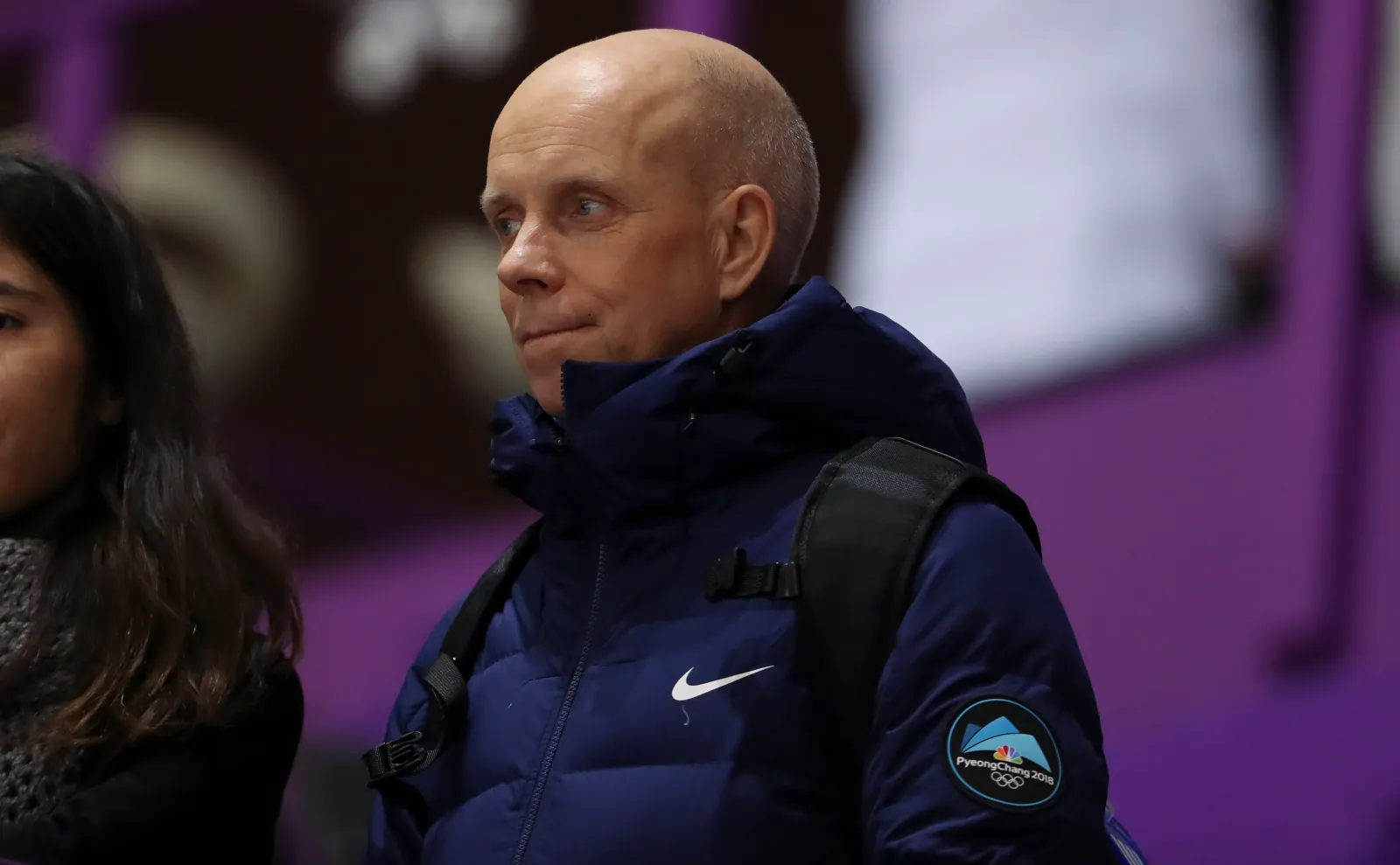
GANGNEUNG, SOUTH KOREA – FEBRUARY 12: NBC analyst Scott Hamilton attends the Figure Skating Team Event during the 2018 Winter Olympic Games at Gangneu… | Photo by Jean Catuffe/Getty Images
On his official X (formerly Twitter) account, Hamilton posted a heartfelt message about how a single performance shouldn’t be the only one tied to an athlete’s story.
“One performance should never define anyone. A good one or a disappointing one. Ilia Malinin is a class act and someone I greatly admire! As badly as I feel for him tonight, I know he will respond with strength, courage, and dignity. We all love you Ilia!” Hamilton wrote.

While footage of Malinin’s performance is available on YouTube, a celebrated Instagram clip also shows his good sportsmanship in offering congratulations to the event’s winner.
While the loss is heartbreaking for Malinin, he is receiving plenty of support from fans, fellow Olympians, and decorated skating medalists. Scott Hamilton won gold at the 1984 Winter Olympics in Sarajevo and achieved four gold medal championships with that.
:max_bytes(150000):strip_icc():focal(999x0:1001x2)/ilia-malinin-2025-us-figure-skating-championships-013025-1-c7075f7f6bcf434f9233a7c00948cf90.jpg)
Hamilton became well known for performing a backflip, which few other competitors could do. While he showed it off to fans during exhibitions, the move violated U.S. Figure Skating and Olympic competition rules.At 21, this undoubtedly isn’t the last that anyone has seen of the phenom known as “Quad God,” as he’ll likely return in four years for the 2030 Winter Olympics at the French Alps in Paris.
The figure skating world fell into stunned silence the moment Ilia Malinin hit the ice. Known globally as “The Quad God” for his unprecedented technical arsenal and historic success landing the quadruple Axel in competition, Malinin has built a reputation on near-mythical consistency. So when an unexpected fall disrupted his latest performance, the shock rippled far beyond the arena. Commentators paused. Fans froze mid-cheer. Social media ignited within seconds.
In elite figure skating, falls are part of the sport’s unforgiving reality. The margin between brilliance and error is razor thin, especially for athletes who push the technical ceiling higher each season. Yet this moment felt different. Malinin is not simply another contender; he represents a generational shift in men’s skating — where explosive athleticism meets evolving artistry. His programs often feel less like routines and more like statements of intent.
As replays circulated, analysts dissected the mechanics: takeoff angle, edge control, rotational speed, landing alignment. Some suggested a slight hesitation before the jump. Others pointed to the mounting pressure of expectation. But beyond technical breakdowns, the emotional dimension quickly became the focus. How would Malinin respond? Would this moment dent his aura of invincibility?
Then, hours later, one of the most respected figures in American skating entered the conversation. Scott Hamilton — Olympic champion, broadcaster, and enduring voice of the sport — broke his silence with a brief ten-word message addressed directly to Malinin.“Champions rise strongest right after the hardest falls.”Ten words. Measured. Calm. Yet instantly powerful.

Coming from Hamilton, the statement carried weight far beyond its length. A gold medalist at the 1984 Sarajevo Olympics and a symbol of resilience throughout his life and career, Hamilton understands both triumph and adversity at the highest level. His words were not dramatic, nor were they critical. Instead, they framed the fall as part of a champion’s narrative rather than a crack in it.
The phrase that set fans debating was “rise strongest.” Some interpreted it as reassurance — a reminder that setbacks are catalysts. Others read it as a subtle challenge, suggesting that true greatness is measured not in flawless performances but in response to imperfection. In a sport where perfection is idolized, the idea that strength emerges from failure resonated deeply.
Social media reaction was immediate. Supporters flooded timelines with clips of Malinin’s past achievements: the quad Axel landing that rewrote history, the record-breaking technical scores, the programs that blended difficulty with surprising musical maturity. Many echoed Hamilton’s sentiment, arguing that a single fall does not diminish a skater’s legacy — especially one built on innovation.
Critics, meanwhile, emphasized the importance of consistency at the elite level. Figure skating scoring leaves little room for major errors in tightly contested competitions. A fall can shift podium outcomes dramatically. For athletes who attempt multiple quadruple jumps, the risk-reward balance is always under scrutiny. Was the fall a sign of overambition? Or simply an inevitable byproduct of pushing boundaries?
Hamilton’s message subtly reframed that debate. By emphasizing resilience rather than error, he redirected attention to mindset. Skating history is filled with champions who endured public setbacks before achieving defining victories. The sport’s emotional arc often hinges not on uninterrupted dominance, but on the courage to return stronger.
Malinin himself has long embraced risk as part of his identity. His rise has been characterized by audacity — attempting elements others hesitate to try, redefining what is technically possible in a single program. That daring approach naturally carries volatility. But it is also what electrifies audiences and propels the discipline forward.
Within hours of Hamilton’s message, analysts began contextualizing the moment within Malinin’s broader trajectory. At just a young age, he has already accomplished feats once considered unattainable. His training regimen, reportedly intense and meticulously structured, reflects a commitment to continuous evolution. Coaches often emphasize that growth in skating is nonlinear; plateaus and setbacks are inevitable stepping stones.
The surprising phrase in Hamilton’s statement — “rise strongest” — also sparked a philosophical conversation. Does adversity refine focus? Can a fall sharpen competitive instinct? Sports psychologists often argue that controlled failure builds adaptive resilience. In that sense, a stumble under bright lights can become a formative experience rather than a defining flaw.